
South Korea’s latest official statistical release on North Korea shows a country that expanded in several sectors in 2024, yet still lagged far behind the South in income, trade, energy, and living standards. The report, released by the Ministry of Data and Statistics on Dec. 23, 2025, gives a rare side-by-side snapshot of the two Koreas using official figures.
Population
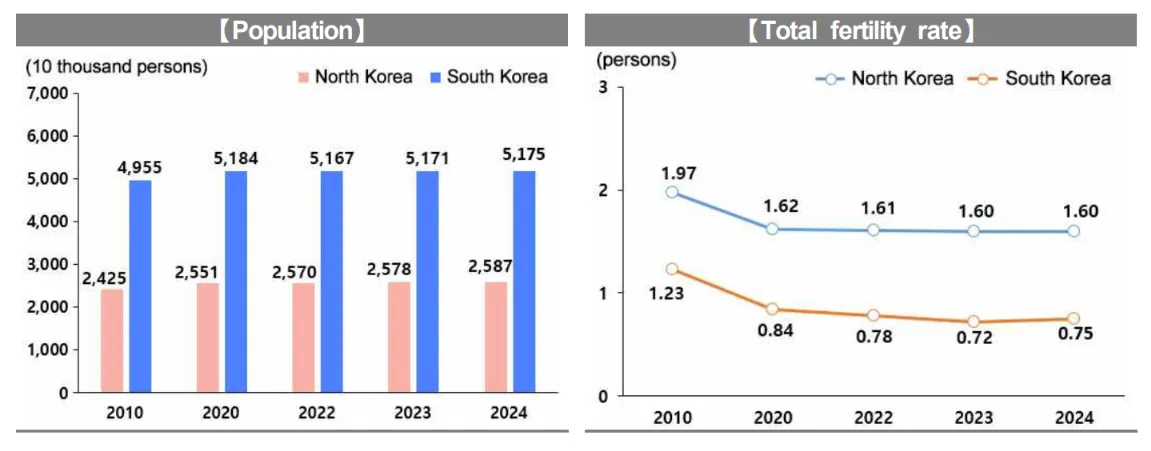
North Korea’s population was estimated at 25.87 million in 2024, about half of South Korea’s 51.75 million. Its total fertility rate stood at 1.60 children per woman, while children aged 0 to 14 made up 18.7 percent of the population and those 65 and older 11.4 percent. South Korea’s elderly share was higher, but North Korea still had a younger population structure overall.
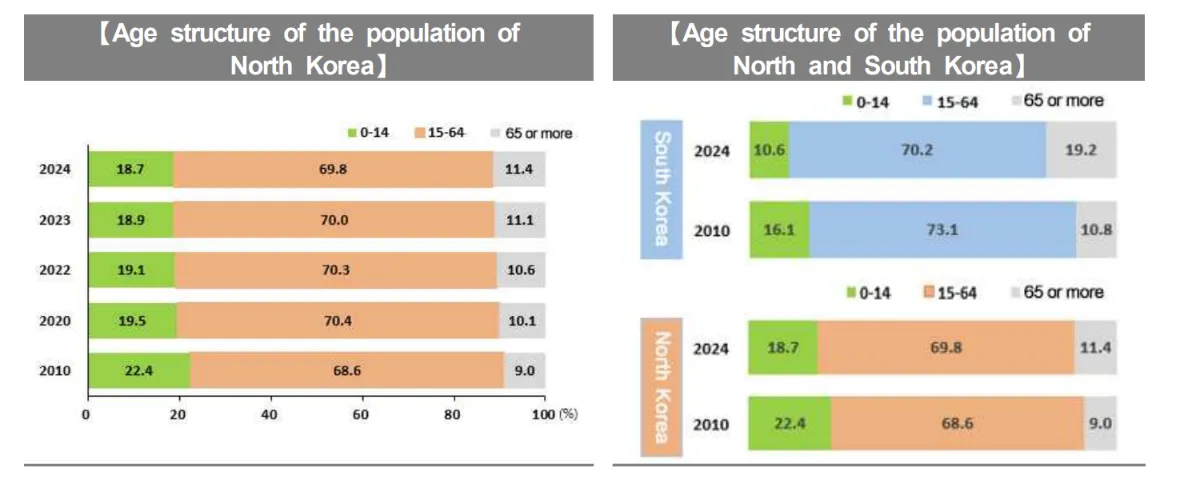
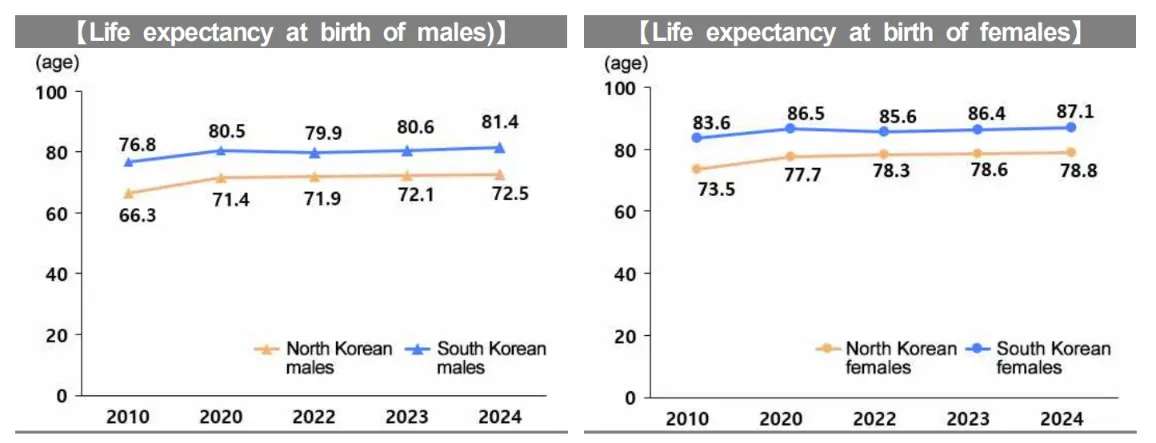
In health, North Korean men were expected to live 72.5 years at birth and women 78.8 years. That was still 8.9 years and 8.3 years lower, respectively, than in South Korea. The numbers point to a wider gap in health outcomes even when the North posts small year-on-year gains.
Agriculture, Industry and Economy
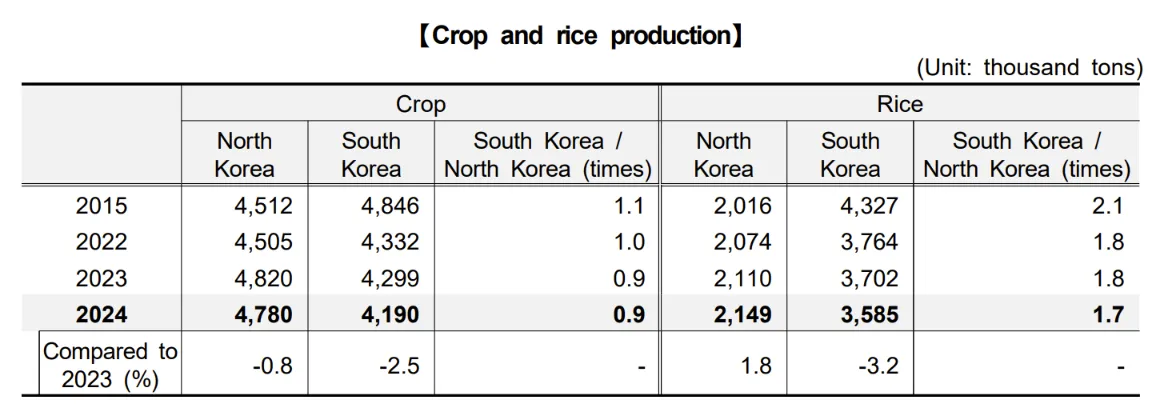
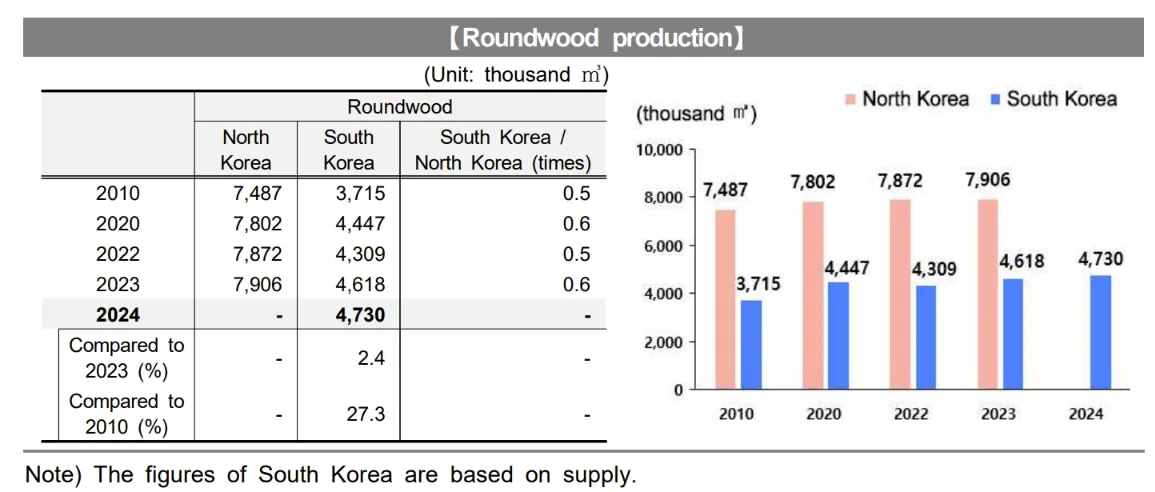
Agriculture remained one of the few areas where North Korea’s output was not dramatically smaller than the South’s. Crop production reached 4.78 million tons in 2024, slightly above South Korea’s 4.19 million tons, while rice production reached 2.15 million tons in the North versus 3.59 million tons in the South. North Korea’s roundwood production also remained higher than South Korea’s, at 7.91 million cubic meters compared with 4.62 million cubic meters in South Korea.
Industry and heavy production showed sharper contrasts. North Korea produced 18.70 million tons of coal and 2.84 million tons of iron in 2024, both higher than South Korea’s figures, while crude steel output was only 510,000 tons, far below South Korea’s 63.65 million tons. Cement output reached 7.20 million tons, and chemical fertilizer production was 740,000 tons. These figures suggest a production structure still tilted toward raw materials and basic inputs rather than advanced manufacturing.
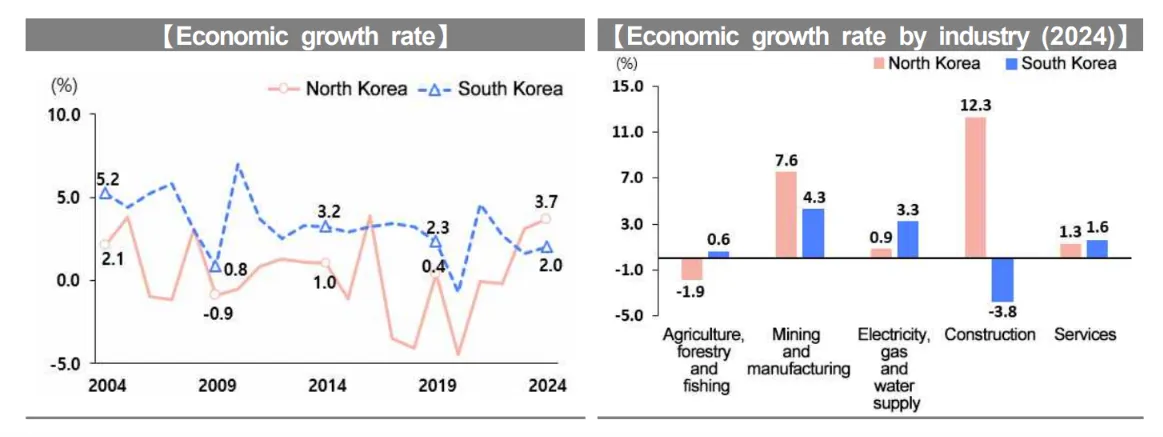
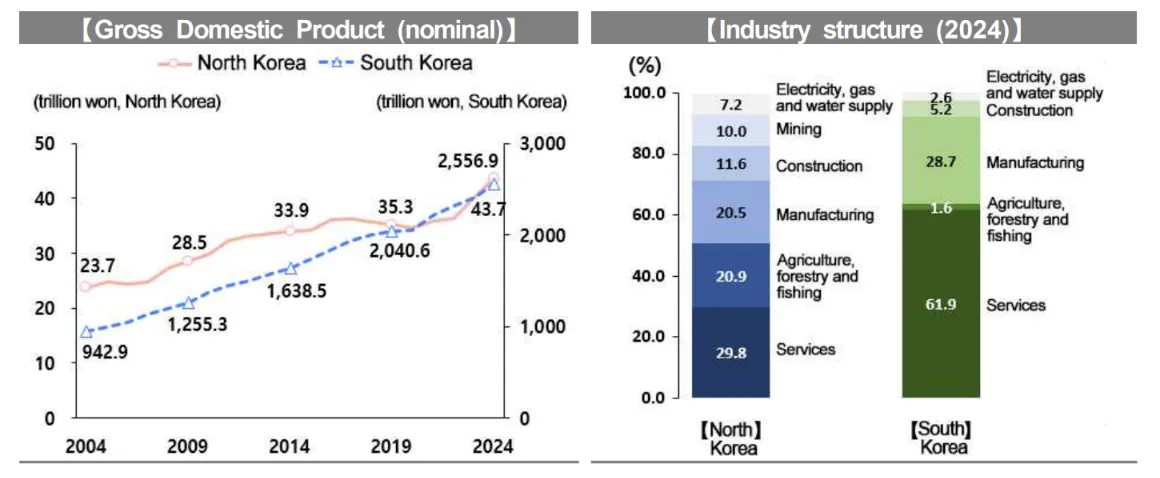
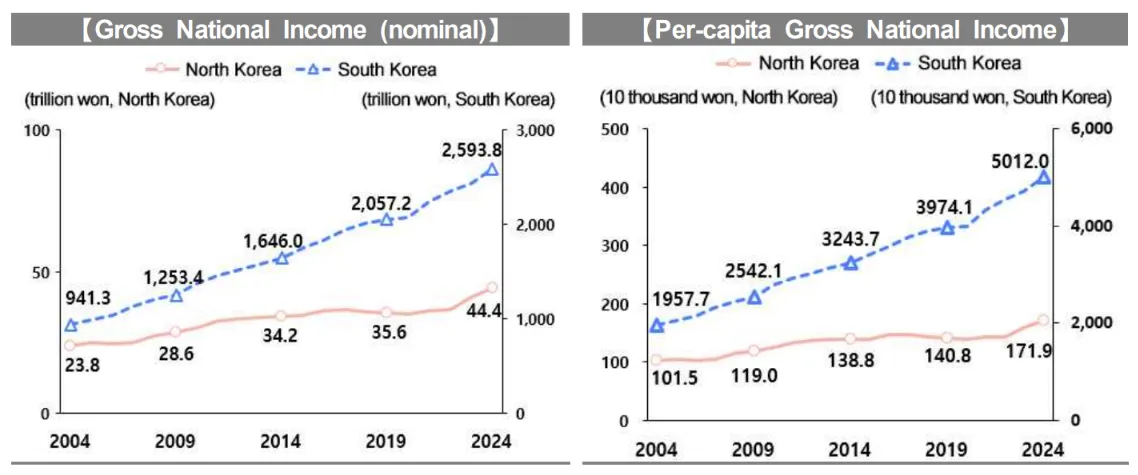
The economy also grew, but from a very small base. North Korea’s real GDP rose 3.7 percent in 2024, and nominal GDP reached 43.7 trillion won, only 1.7 percent of South Korea’s 2,556.9 trillion won. Per-capita GNI was 1.719 million won in the North, compared with 50.12 million won in the South. Trade showed an even larger divide: North Korea’s total foreign trade was 2.7 billion dollars, while South Korea’s reached 1,315.4 billion dollars.
Transport, logistic and Energy
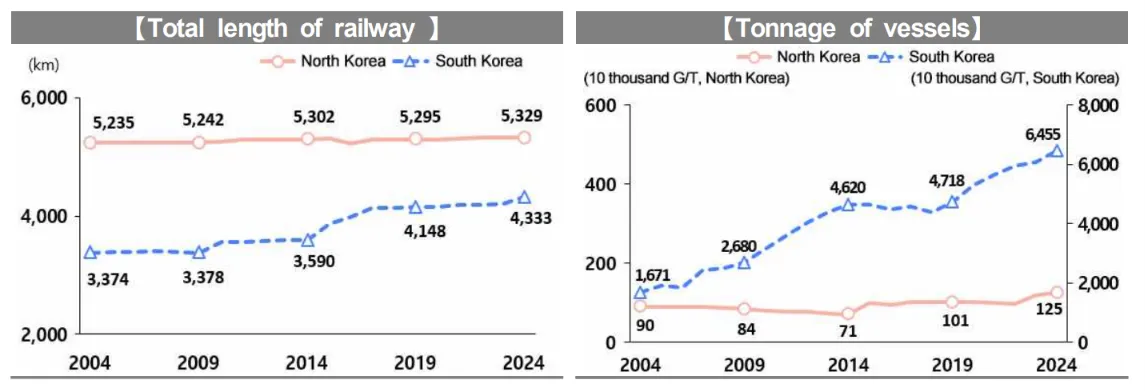
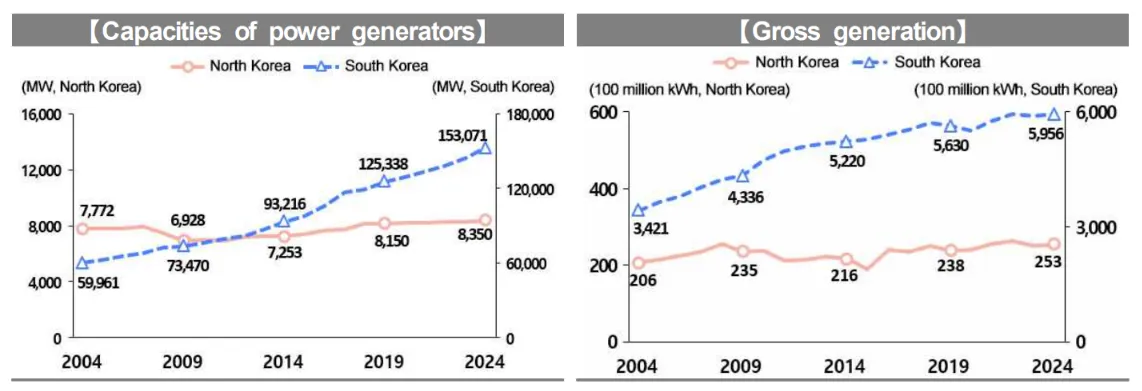
Transport and energy reveal the same pattern. North Korea’s railway network was longer at 5,329 kilometers, compared with South Korea’s 4,333 kilometers, but its port cargo handling capacity, vessel tonnage, installed power capacity, and electricity generation all trailed far behind the South. North Korea’s power generators totaled 8,350 megawatts, while annual gross generation was 25.3 billion kilowatt-hours, versus 595.6 billion in South Korea.
On education and diplomacy, North Korea had 208 university students per 10,000 people, less than half of South Korea’s 518.9. The country maintained diplomatic relations with 159 countries as of December 2024 and memberships in 32 international organizations as of July 2025.
Overall comparison
| Category | North Korea | South Korea | Comparison |
|---|---|---|---|
| Population | 25.87 million | 51.75 million | South Korea has about 2 times the population. |
| Total fertility rate | 1.60 | Not listed in the release | North Korea’s fertility rate is given in the release, but no South Korea figure is included in the same document. |
| Share of population aged 0–14 | 18.7% | 10.6% | North Korea’s child share is 8.1 percentage points higher. |
| Share of population aged 65+ | 11.4% | 19.2% | North Korea’s elderly share is 7.8 percentage points lower. |
| Male life expectancy | 72.5 years | 81.4 years | North Korean men live 8.9 years less on average. |
| Female life expectancy | 78.8 years | 87.1 years | North Korean women live 8.3 years less on average. |
| Crop production | 4.78 million tons | 4.19 million tons | North Korea produced slightly more crops overall. |
| Rice production | 2.15 million tons | 3.59 million tons | South Korea produced more rice. |
| Roundwood production | 7.91 million m3 | 4.62 million m3 | North Korea produced more roundwood. |
| Coal production | 18.70 million tons | 0.54 million tons | North Korea produced far more coal. |
| Iron production | 2.84 million tons | 0.39 million tons | North Korea produced more iron. |
| Crude steel production | 0.51 million tons | 63.65 million tons | South Korea produced far more crude steel. |
| Cement production | 7.20 million tons | 44.19 million tons | South Korea produced more cement. |
| Chemical fertilizer production | 0.74 million tons | 1.72 million tons | South Korea produced more fertilizer. |
| Real GDP growth | 3.7% | Not listed in the release | North Korea’s economy grew in 2024, but the release does not place a matching South Korea growth figure in the same section. |
| Nominal GDP | 43.7 trillion won | 2,556.9 trillion won | South Korea’s GDP was 59 times larger. |
| Per-capita GNI | 1.719 million won | 50.12 million won | South Korea’s per-capita GNI was 29 times higher. |
| Foreign trade | 2.7 billion dollars | 1,315.4 billion dollars | South Korea’s trade was 488 times larger. |
| Railway length | 5,329 km | 4,333 km | North Korea’s railway network was longer. |
| Port cargo handling capacity | 44 million tons | 1,415 million tons | South Korea handled far more port cargo. |
| Vessel tonnage | 1.25 million G/T | 65.78 million G/T | South Korea had far larger vessel tonnage. |
| Installed power capacity | 8,350 MW | 153,000 MW | South Korea’s power capacity was much higher. |
| Electricity generation | 25.3 billion kWh | 595.6 billion kWh | South Korea generated far more electricity. |
| University students per 10,000 population | 208.0 | 518.9 | South Korea had a much higher student ratio. |
| Diplomatic relations | 159 countries | Not listed in the release | North Korea maintained diplomatic relations with 159 countries as of Dec. 2024. |
| Memberships in international organizations | 32 | Not listed in the release | North Korea held 32 memberships as of July 2025. |
North Korea’s latest official statistics show a mixed picture: the economy grew in 2024, and several industrial outputs rose, but the overall scale of the country’s economy and living standards remained far below South Korea’s. Population, income, trade, energy, and education figures all point to a persistent structural gap, even where North Korea posted gains in coal, iron, construction-linked growth, and some agricultural output.
All the stats and graphs are credited to Ministry of Data and Statistics, Republic of Korea.
Comments